Ruby Laser 694nm: The Gold Standard for Challenging Tattoos Colors
Ruby Laser 694 nm: Why It Remains One of the Gold Standards in Advanced Tattoo and PMU Removal
When people think about laser tattoo removal, they often focus on the newest technology. However, experienced practitioners know that successful tattoo removal is not about using one laser for every situation.
It is about choosing the right wavelength for the right pigment.
This is exactly why Ruby Laser 694 nm continues to be considered one of the most valuable and respected technologies in advanced tattoo and permanent makeup removal.
Why Do Eyebrows Turn Green ? Laser Eyebrow Tattoo Removal Guide
What Makes Ruby Laser Different?
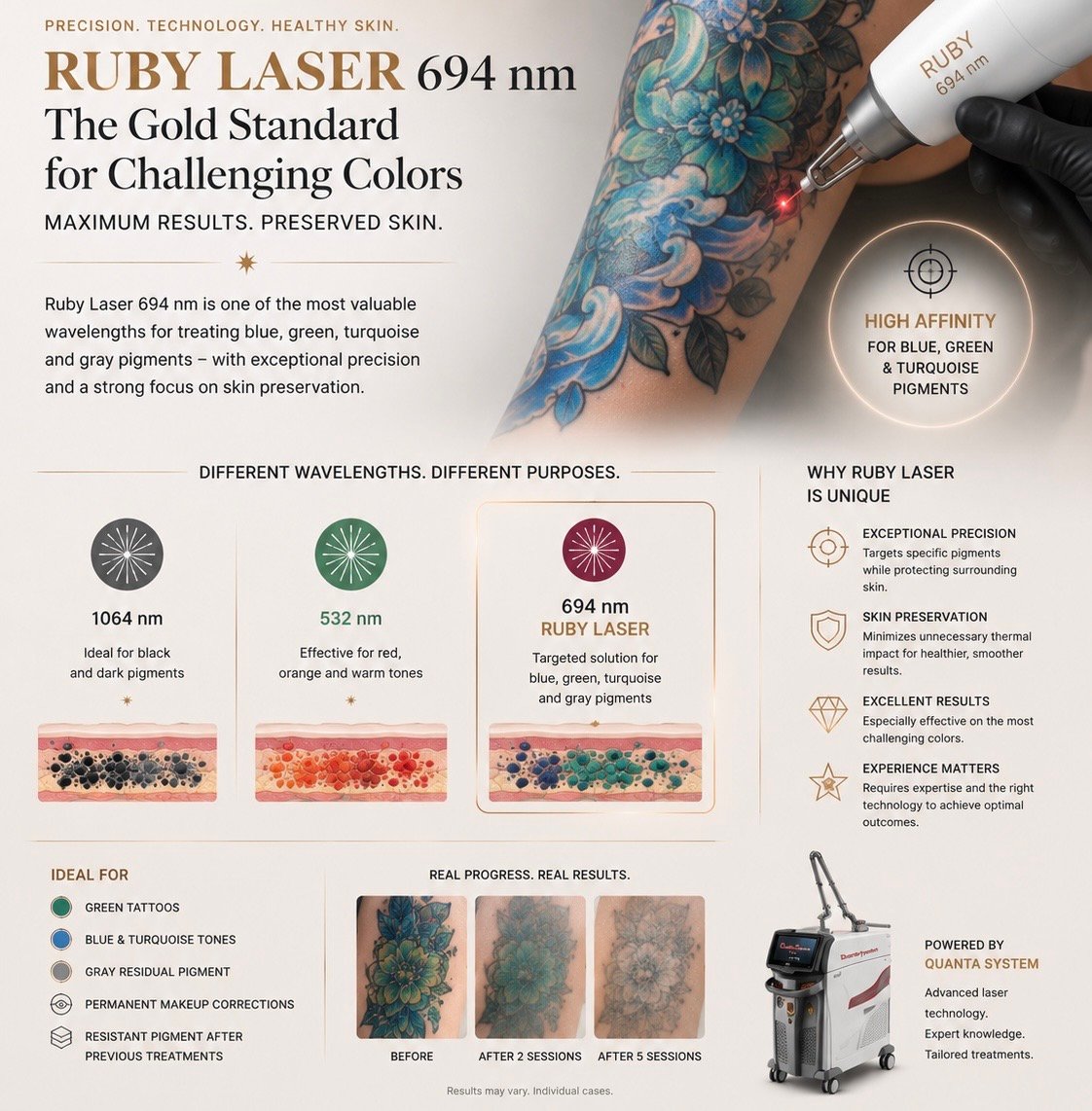
Every pigment absorbs laser energy differently.While some wavelengths perform exceptionally well on black or red pigments, Ruby Laser 694 nm is particularly effective when treating certain green, blue, turquoise, and gray pigments that are often considered among the most challenging colors in tattoo removal.This unique absorption profile allows the laser to focus energy where it is needed most while minimizing unnecessary impact on surrounding tissue.
Not All Pigments Respond the Same Way
Different tattoo colors absorb laser energy differently.
Black pigments typically respond very well to 1064 nm wavelengths.
Red and orange pigments often respond to 532 nm wavelengths.
Certain green, blue, turquoise, and gray pigments, however, can be more challenging and may require a different approach.
This is where Ruby Laser 694 nm offers a unique advantage.
Its wavelength has a strong affinity for specific pigments that are often considered among the most difficult to remove.
Advanced Colored Tattoo Removal And Pigment-Specific Laser Technology
How Many Sessions Are Needed To Remove A Tattoo?
Precision Is the Real Advantage
The true value of Ruby Laser is not simply its ability to remove pigment.
Its value lies in precision.
The more selectively a wavelength is absorbed by the target pigment, the more effectively energy can be delivered where it is needed while minimizing unnecessary impact on surrounding tissue.
For patients, this means a treatment approach focused not only on pigment removal, but also on preserving healthy skin.
Why Skin Preservation Matters
Removing ink is only part of the goal.
Professional tattoo removal should also protect the skin's natural texture, tone, and appearance throughout the process.
A great result is not measured only by how much pigment disappears.
It is also measured by the quality of the skin that remains.
This philosophy is one of the reasons Ruby Laser has maintained its reputation for decades among clinics specializing in advanced pigment removal.
Laser Tattoo Removal: Why Choosing the Right Technology and Clinic Matters
Ruby Laser and Difficult Colors
Ruby Laser 694 nm is particularly valued when treating:
- Green tattoo pigments
- Blue and turquoise pigments
- Gray residual pigment
- Complex permanent makeup corrections
- Resistant pigment remaining after previous treatments
These are often the cases where having access to additional wavelengths can make a meaningful difference.
Why Can Tattoo Removal Stop Working After Many Sessions?
Why Choosing the Wrong Laser Can Damage Your Skin
Why Experienced Clinics Use Multiple Wavelengths
Professional tattoo removal is similar to using a set of specialized tools.
No single wavelength is designed for every pigment.
Each wavelength has strengths depending on the color, composition, and stage of the removal process.
For this reason, advanced clinics focus on treatment strategy rather than relying on a single laser technology.
The goal is always to select the most effective wavelength for the specific pigment being treated.
Our Approach at Laser House TLV
At Laser House TLV, we believe that successful tattoo and PMU removal begins with proper assessment, accurate pigment analysis, and careful treatment planning.
Ruby Laser 694 nm is one of the advanced technologies that allows us to address challenging pigments while maintaining our highest priority: healthy skin.
Laser Tattoo Removal FAQ: The Most Common Questions
Discovery Pico VarioPulse®: Why Advanced Laser Technology Matters
Our goal is simple:
Maximum pigment clearance. Minimal skin trauma. Natural-looking results.
Because great tattoo removal is not about using the strongest laser.
It is about using the right wavelength, at the right stage, for the right pigment.